


Bitcoin is often described simply as “digital money,” yet its internal mechanics are far more sophisticated and revolutionary. Behind every Bitcoin transaction is a complex ecosystem of cryptography, decentralized consensus, network rules, and global coordination at a scale no central organization manages. When someone sends Bitcoin — for example, Alice transferring 0.1 BTC to Bob — the network performs a series of meticulous steps to verify, secure, validate, and permanently record that transaction.
Understanding this flow is essential not only for investors, developers, and blockchain professionals, but also for lawyers, auditors, compliance officers, cybersecurity experts, and regulators—because Bitcoin’s transaction architecture defines the foundation of the decentralized financial world.
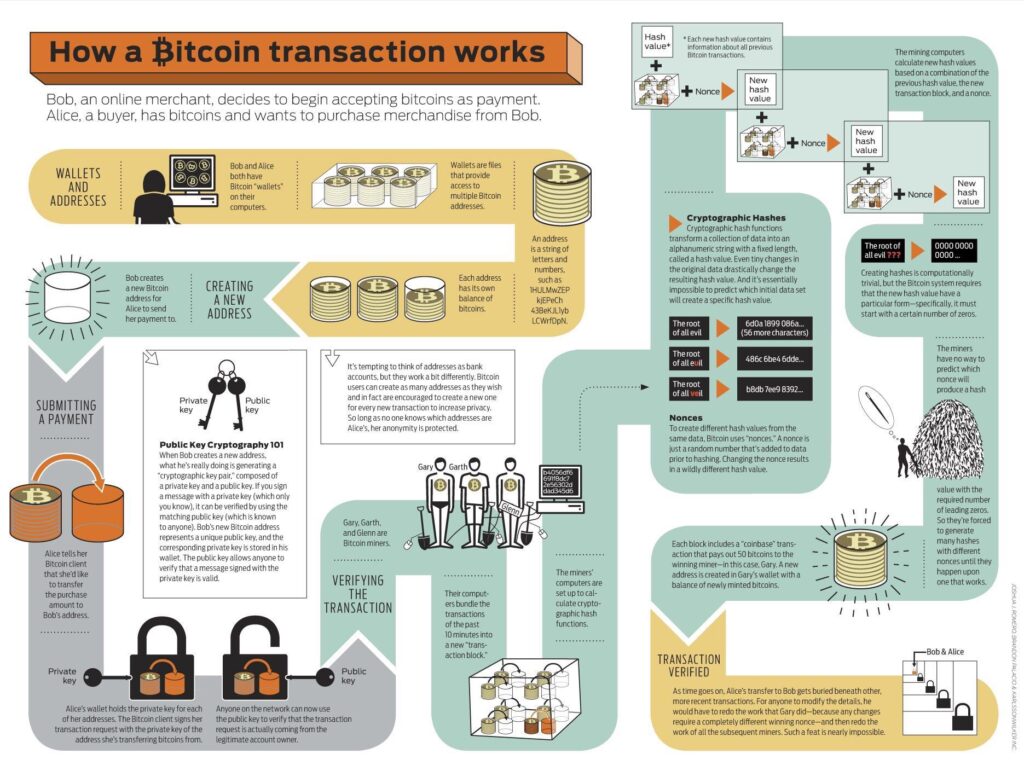
Let’s take a deeper look at this journey.
1. Transaction Creation — The Birth of a Bitcoin Transaction
The transaction lifecycle begins inside a Bitcoin wallet, which may be a mobile app, desktop application, hardware wallet, or even a paper wallet.
This first stage involves crafting a precise data structure, known as a transaction, which contains:
Inputs (UTXOs)
Bitcoin doesn’t track balances like banks. Instead, it uses Unspent Transaction Outputs (UTXOs)—pieces of Bitcoin received from previous transactions.
Alice’s wallet must gather enough UTXOs to cover the amount she wants to send.
Outputs
A transaction typically has:
- The receiver’s Bitcoin address (Bob)
- A change address (Alice’s wallet) — where leftover BTC returns after deducting fees
This ensures Bitcoin works like cash: if you pay with a ₹500 note for a ₹300 item, you receive ₹200 back.
Transaction Fee
Fees incentivize miners. Higher fees result in faster confirmations. Fees are based on:
- Network congestion
- Transaction size (bytes)
- Market fee rates (sats per byte)
Wallets usually auto-recommend optimal fees.
Constructing the Transaction
When Alice selects “Send 0.1 BTC to Bob,” the wallet:
- Selects UTXOs
- Calculates change
- Estimates fees
- Assembles a valid transaction
This step is where the entire journey begins — with a carefully structured, mathematically precise digital message.
2. Digital Signing — Proving Ownership Securely
A Bitcoin transaction must be cryptographically signed before it becomes valid. This signature acts as a digital seal of authorization.
How it works:
- Alice’s wallet uses her private key to sign the transaction.
- The private key never leaves the wallet—only the signature does.
- Anyone can verify the signature using Alice’s public key.
Why digital signatures matter
- Authentication — confirms the true owner sent the transaction
- Integrity — if the transaction is altered, the signature becomes invalid
- Security — no one else can spend her Bitcoin without the private key
This is one of Bitcoin’s most genius innovations: a secure, trustless system where ownership is mathematically verified.
3. Broadcasting — Sending the Transaction into the Bitcoin World
Once signed, the transaction is released into the global Bitcoin peer-to-peer (P2P) network.
What happens during broadcasting?
- The wallet sends the transaction to a few connected nodes.
- Those nodes validate it and relay it forward.
- Very quickly, the transaction propagates across the entire Bitcoin ecosystem.
Within seconds, thousands of decentralized nodes worldwide know that Alice attempted to send Bitcoin to Bob.
This propagation is what makes Bitcoin censorship-resistant — no central authority can block a valid transaction.
4. Node-Level Validation — The Network’s First Line of Defense
Nodes act as independent auditors.
Every node that receives the transaction must perform a full validation.
Nodes verify:
- Whether the digital signature is valid
- Whether the inputs are real, unspent UTXOs
- Whether Alice is not trying to double-spend
- Whether the transaction follows protocol rules
- Whether fees are within reasonable limits
- Whether the transaction size and structure are correct
Only after passing these checks does the transaction get added to the node’s mempool.
If any rule is violated, the transaction is rejected instantly.
This decentralized validation makes Bitcoin extremely robust — every node enforces the rules independently.
5. The Mempool — The Waiting Room of the Bitcoin Network
The mempool (memory pool) is a temporary holding area that stores unconfirmed transactions.
Characteristics of the mempool:
- Each node maintains its own mempool
- Some nodes may have slightly different mempool content
- Transactions remain here until a miner selects them
What affects time spent in the mempool?
- Transaction fee
- Network traffic
- Transaction size
- Miner behavior
High-fee transactions rise to the top; low-fee ones can remain for hours or get dropped during congestion.
6. Miner Selection — Choosing Which Transactions Enter the Blockchain
Miners are like block-makers deciding which transactions to include.
They gather transactions from their mempool and build a candidate block.
Miners prioritize:
- Highest-fee transactions
- Valid transactions only
- Transactions that maximize total block reward
Since miners earn transaction fees + block reward, they strategically optimize which transactions to select.
A block can include roughly 2,000 to 3,000 transactions, depending on block size and SegWit data compression.
7. Proof of Work — The Global Competition to Secure Bitcoin
Now the real race begins.
Miners attempt to solve a computational puzzle requiring immense energy and hardware power.
How Proof of Work works:
- Miners try to find a hash value below Bitcoin’s difficulty target.
- This requires trillions of attempts.
- The first miner to find a valid hash earns the right to finalize the block.
Purpose of Proof of Work:
- Prevents fraud
- Enforces decentralization
- Secures the network
- Makes attacks expensive and nearly impossible
It is the backbone of Bitcoin’s security model.
8. Block Broadcasting — A New Block Is Born
The winning miner broadcasts their newly mined block to all nodes.
Nodes then verify:
- The block hash
- All included transactions
- The validity of the Proof of Work
- Compliance with consensus rules
- Correct block structure
- Correct reward amount
If valid, the block is added to the node’s local blockchain copy.
Alice’s transaction now receives its first confirmation.
9. Confirmations — Strengthening the Transaction’s Finality
Bitcoin’s security grows with every new block built on top of the block containing Alice’s transaction.
Confirmation standards:
- 1 confirmation: Generally safe for small amounts
- 3 confirmations: Medium-security level
- 6 confirmations: High-value industry standard
- 100+ confirmations: Ultimate immutability
Each confirmation exponentially increases the cost of reversing the transaction — making it practically impossible.
10. Finality — The Transaction Becomes Permanently Part of Bitcoin’s History
After enough confirmations, Alice’s transaction is fully final and irreversible.
Bitcoin finality ensures:
- Absolute immutability
- No chargebacks
- No central authority intervention
- No double-spending
- Permanent inclusion in global financial history
Once finalized, Alice’s transfer to Bob is forever etched into Bitcoin’s distributed ledger.
This is the essence of Bitcoin:
a global, neutral, tamper-proof financial network governed by math—not institutions.
Why Understanding Bitcoin’s Transaction Flow Is Crucial
For Investors
- Helps understand delays
- Improves fee management
- Encourages security best practices
For Developers
- Essential for wallet and protocol design
- Helps manage mempool and fee logic
- Enables efficient app architecture
For Legal & Compliance Professionals
- Critical for blockchain forensics
- Supports AML/CFT investigations
- Helps understand transaction immutability in cases of fraud
For Businesses
- Enhances audit trails
- Ensures regulatory compliance
- Enables secure blockchain integrations
Understanding the transaction flow transforms Bitcoin from a “mysterious digital coin” into a transparent, predictable, and highly secure system.