


Cryptocurrency has grown into a trillion-dollar industry, attracting investors, developers, institutions, and innovators from every corner of the world. But behind the extraordinary rise of digital assets lies another story — a history of massive financial losses, scams, hacks, cyber-thefts, and user errors that have cost the global crypto community tens of billions of dollars.
Unlike traditional banking, where laws, insurance, and authorities protect investors, cryptocurrency operates in a high-risk, decentralized environment where a single mistake, breach, or scam can permanently erase funds. As a result, no area of crypto has been untouched by loss — from beginners to exchanges, from institutional platforms to decentralized finance (DeFi) protocols.
This article explores the types of losses, historical incidents, annual global shockwaves, and the real reasons people lose money in the crypto ecosystem.
1. Understanding “Loss” in Cryptocurrency
When discussing “total money lost,” it is important to break it down because crypto losses occur in several different ways:
A. Hacks & Exploits
This includes:
- Exchange hacks
- DeFi protocol exploits
- Bridge hacks
- Smart contract vulnerabilities
- Wallet drains
- Private key compromises
These losses are usually irreversible and often measured in billions per year.
B. Scams & Fraud
Crypto scams have exploded worldwide, especially:
- Ponzi schemes
- Rug pulls
- Fake tokens
- Investment fraud
- Romance/“pig-butchering” scams
- Social engineering attacks
- Fake exchanges/wallets
These account for some of the largest global losses each year.
C. Personal mistakes & user errors
A huge silent category:
- Lost private keys
- Wrong wallet transfers
- Sending crypto to the wrong chain
- Mismanaging seed phrases
- Throwing away hardware wallets
Some researchers estimate over 20% of all Bitcoin may be lost forever due to user error.
D. Market crashes & collapses
Crypto’s volatility has caused trillions in unrealized losses during crashes like:
- 2018 bear market
- 2021–2022 downturn
- Collapse of Terra Luna
- Bankruptcy of FTX
- Failures of Celsius, Voyager, BlockFi
These did not always involve theft, but massive value destruction.
2. How Much Money Has Actually Been Lost Globally?
There is no single exact number, because losses depend on:
- Market conditions
- Underreporting
- Private transactions
- Unreported scams
- Personal losses people never reveal
But global reports give a clear picture of the scale:
A. Hacks alone typically range between $1B to $4B every year
The worst year on record was 2022, when crypto hacks reached approximately $3.8 billion worldwide.
B. Scams & fraud exceed $10B+ annually
Some years see even larger numbers because scammers target:
- Retail investors
- Elderly
- Non-technical users
- Crypto beginners
C. Illicit crypto transactions (criminal flows) exceed $40B+ some years
This is not all “lost money,” but shows the broader magnitude of illicit activity in the crypto ecosystem.
D. Total global losses from hacks + scams + platform collapses likely exceed $100B+ over time
If we account for:
- Exchange hacks (Mt. Gox, Coincheck, BitGrail, etc.)
- Protocol exploits
- Major collapses (FTX alone wiped out $8–10B+)
- Personal lost keys
- Unclaimed Bitcoin
- Stolen crypto
- Rug pulls
- Value destruction in crashes
The real number is staggering.
3. Major Historical Crypto Losses: The Incidents That Shocked the World
Crypto’s history is marked by several catastrophic events. Here are some of the largest:
1. Mt. Gox (2014) — $460 million lost
The world’s largest Bitcoin exchange at the time collapsed after a massive hack, wiping out 7% of all Bitcoins in existence back then.
2. Coincheck Hack (2018) — $530 million stolen
One of the largest single thefts in crypto history, involving NEM tokens.
3. Poly Network (2021) — $610 million hacked
A DeFi cross-chain protocol exploit that momentarily shook the entire crypto world. (Funds were later returned.)
4. Terra Luna Collapse (2022) — $60 billion erased
A catastrophic algorithmic stablecoin failure that destroyed life savings, bankrupted investors, and sent shockwaves across global markets.
5. FTX Bankruptcy (2022) — $8 to $10 billion missing
One of the biggest financial scandals, wiping out millions of investors and damaging trust across the global crypto ecosystem.
6. Ronin Bridge Hack (2022) — $625 million
A gaming-related blockchain hack used by Axie Infinity.
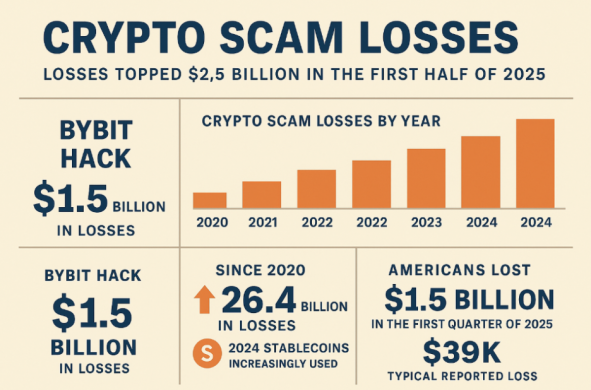
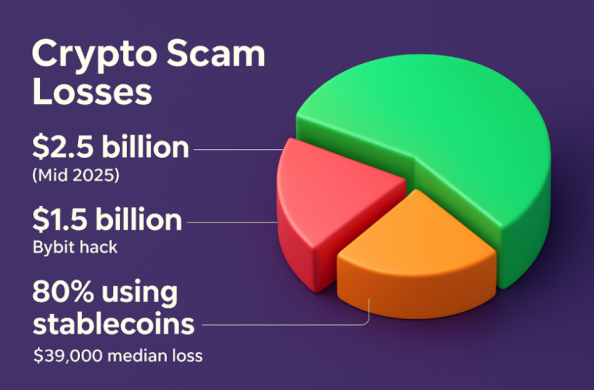
7. ByBit Hack (2025) — $1.5 billion theft
One of the largest single-exchange hacks of the decade.
These events form just the tip of the iceberg.
4. Why Do People Lose Money in Cryptocurrency? (Root Causes)
Crypto losses fall into four main categories:
A. Lack of Regulation & Consumer Protection
Crypto is global, fast-moving, and decentralized.
There is:
- No central authority
- No refunds
- No insurance
- No FDIC safety net
- No guaranteed recovery
Once funds leave your wallet, it’s often irreversible.
B. High Technical Complexity
Users must understand:
- Private keys
- Wallets
- Blockchains
- Gas fees
- Network differences
- Smart contracts
One wrong step can wipe out everything.
C. Scammers Targeting Beginners
Crypto scams use:
- Fake apps
- Social media impersonation
- Romance fraud
- Investment promises
- Pump and dump groups
- Fake trading signals
Because transactions cannot be reversed, scammers thrive.
D. Platforms Mismanaging Funds (like FTX, Celsius, BlockFi)
Some platforms:
- Misuse customer assets
- Over-leverage
- Lack proper audits
- Operate like unregulated banks
This leads to massive collapses.
5. Total Losses: A Realistic Global Estimate
Taking everything into account:
✔ Hacks (2011–2025): ~ $25–30 billion+
Across thousands of incidents.
✔ Scams & fraud (2017–2025): ~ $40–60 billion+
Due to global retail targeting.
✔ Exchange/platform failures: ~ $15–20 billion+
FTX, Celsius, Voyager, QuadrigaCX, etc.
✔ Lost private keys / unclaimed Bitcoin: ~ $100+ billion
Some analyses estimate 3–4 million BTC lost forever.
✔ Market collapses: trillions in value disappeared
(Not counted as “lost” because markets fluctuate.)
Total estimated crypto losses (all categories combined):
👉 Easily over $150–200+ billion globally.
And likely much higher when including individual investor losses that are never reported.
6. What Can Investors Do to Stay Safe?
Here are the golden rules of crypto protection:
1. Never share your private keys or seed phrase
Not with anyone. Ever.
2. Use hardware wallets for long-term storage
Ledger, Trezor, Keystone, etc.
3. Avoid “too good to be true” investments
If someone promises guaranteed returns — it’s a scam.
4. Verify all websites / exchanges
Double-check URLs, apps, and integrations.
5. Learn before investing (DYOR)
Knowledge is your strongest protection.
6. Follow proper tax & legal compliance
This protects you from penalties and fraud risks.
7. Use regulated and reputed exchanges
Especially in India — where compliance matters.
7. Final Conclusion
Crypto’s potential is world-changing, but its risks are equally massive. Over the last decade, global crypto losses have crossed hundreds of billions of dollars, driven by:
- Hacks
- Frauds
- Ponzi schemes
- Human error
- Platform failures
- Lack of awareness
Yet, despite these losses, the crypto industry continues to grow, evolve, and attract serious global investment.
As the world enters a new era of digital finance, the real opportunity lies in education, regulation, compliance, and security — ensuring that innovation moves forward without sacrificing consumer protection.
Crypto will continue to rise. The key question is whether users will rise with knowledge, or fall to the dangers they don’t yet understand.
Tools for Scam Detection
| Tool | Purpose |
|---|---|
| Chainalysis | Tracks blockchain transaction flows and identifies suspicious patterns |
| Elliptic | Provides wallet risk ratings and illicit activity detection |
| MetaMask + ScamSniffer | Detects phishing websites, malicious URLs, and unsafe transactions |
| Google Trends | Monitors public sentiment spikes related to potential scam activity |
| Python + Pandas | Enables custom modeling for unusual transaction behavior |
Legal & Regulatory Status
| Region | Regulatory Body | Key Actions |
|---|---|---|
| USA | SEC, CFTC, DOJ | Prosecutes crypto crimes, enforces securities laws, cracks down on fraud |
| India | RBI, ED | Restricts unregulated crypto exchanges, investigates financial fraud and laundering |
| EU | MiCA Framework | Regulates digital assets, enforces AML/KYT norms, mandates strict compliance |
Key Challenges
| Challenge | Description |
|---|---|
| Decentralized Exchanges & Mixers | Scammers use decentralized platforms and mixing services, making transaction tracing difficult |
| Cross-Border Enforcement | Lack of global treaties and coordination slows down international investigations |
| Anonymous Wallets | Pseudonymous transactions enable fraudsters to hide their identity easily |
| High Technical Complexity | Users often fail to recognize malicious contracts, phishing, or exploit patterns |
| Rapidly Evolving Scam Methods | Fraud techniques change faster than regulatory frameworks and detection tools |